Review one cell against both its row and column headers. Preserve the table name, unit and relationship in the published HTML.
Define the question each axis answers
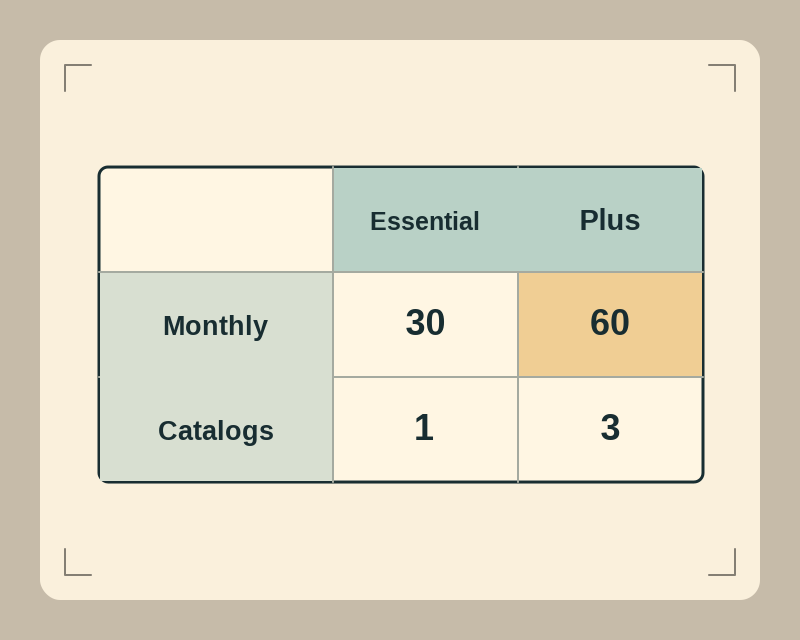
In the example, the columns are Essential and Plus; the rows are Monthly fee and Included catalogs. Amounts are in currency units per month, and catalogs are monthly quantities. Keep that distinction visible. A short caption identifies the whole as “Fictional plan comparison.”
Mark headers and data by their roles
In a simple HTML table with headers across the top and down the left, use th scope="col" for Essential and Plus, and th scope="row" for Monthly fee and Included catalogs. Values belong in td. W3C explains how scope associates headers with their cells. Making a td bold changes its appearance, but does not turn it into a th.
Reconstruct the cell containing 60
Essential costs 30 per month and includes one catalog; Plus costs 60 and includes three. The 60 cell answers Monthly fee and Plus. The 3 cell answers Included catalogs and Plus. This is a structural example with no commercial offer behind it. Retain the same rule when amounts change.
| Measure | Essential | Plus |
|---|---|---|
| Monthly fee | 30 | 60 |
| Included catalogs per month | 1 | 3 |
Test the published reading experience
Use a screen reader's table navigation and check which headers it announces at 60 and 3. Record the reader, browser and version. Also inspect a narrow screen: if horizontal scrolling appears, the table should remain navigable without losing access to the rest of the page. HTML inspection and a reading test provide complementary evidence.
Preserve relationships during redesign
If a mobile layout turns rows into cards, check that each value still clearly belongs to its plan and measure, visually and through assistive technology. Merged cells and multilevel headers need a different analysis. For this simple table, keep a screenshot, the markup and the observed result as a reference for the next edition.
Follow the evidence.
Sources checked November 20, 2026. The exercise scenarios and figures are fictional. Our editorial standards.