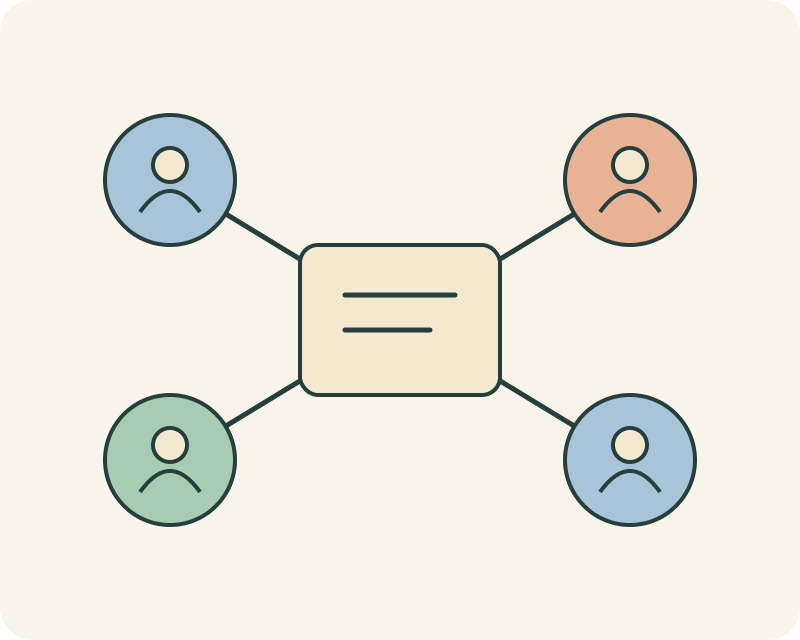
Ask what function each participant performs in this purchase. Confirm the process with your contact and record unknown roles without inventing a hierarchy.
Define the purchase under discussion
Specify the decision: buying a digital catalog service for a fictional distributor, for example. The map concerns that purchase at that moment. It is not a permanent assessment of people or an organizational chart you can infer from job titles alone.
OpenStax describes six possible functions: initiating a need, influencing criteria, filtering information or access, managing the purchase, deciding and using the solution. One person can perform several functions, and a purchase may not involve them all. We use this conceptual distinction for the exercise below.
An example with overlapping functions
At the imaginary distributor, Laura notices errors when sending product sheets and would use the new catalog. Mateo checks whether required fields are available. Inés coordinates offers and terms. Nobody has yet confirmed who can approve the expense. That function remains pending even though Laura requested a demonstration.
| Person or function | What we know | What needs confirmation |
|---|---|---|
| Laura | Identifies the need and would use the catalog | Which task she needs to complete |
| Mateo | Reviews fields and requirements | How he communicates his assessment |
| Inés | Coordinates offers and terms | Which documents she needs |
| Approval | Unconfirmed | Who decides and through which process |
The people and company are fictional. The map shows questions to resolve without claiming that a real sales opportunity exists.
Ask your contact about the process
You might ask: “Who would use the catalog?”, “Who reviews requirements?” and “How is the buying decision made?”. Add: “What would be the appropriate way to share this information with those people?”. Your contact’s invitation does not automatically authorize contacting the entire organization.
If someone coordinates access or scheduling, ask which format and channel they need. Avoid treating that function as an obstacle to bypass. If the process has not been defined, record the uncertainty and agree which clarification would help.
Prepare information for the task
Laura might need to see how to correct a product sheet; Mateo, a list of fields and limitations; Inés, scope and terms for comparing offers. These are possible materials to confirm before preparing them. Different functions do not require contradictory versions of the same proposal.
Keep a common document with references to relevant sections. If two participants request incompatible things, return the question to the customer’s decision process. Do not separately promise two scopes your team cannot deliver together.
Record confirmation and assumptions separately
For each function, note how it was confirmed and when to review it. “Inés said she coordinates offers” differs from “Inés seems to control the budget”. Keep only the information needed to coordinate this purchase, avoiding personal observations unrelated to the task.
If your contact changes, confirm continuity of the process before forwarding documents. Receiving an email or attending a meeting does not demonstrate final approval.
Agree one small next clarification
Close by summarizing the known functions and one open question, such as asking Inés which step authorizes the purchase. Assign that clarification to a person and an agreed time; do not turn it into an invented customer obligation.
The related discovery guide helps understand the problem. This map adds who participates and what they need for their function; terms and the final decision still need confirmation in the real process.
Follow the evidence.
Sources checked October 31, 2026. Illustrative cases, people, codes and numbers are fictional. These are original editorial proposals and exercises, without claiming actual server-log analysis, store tests, sowing or customer results. Our editorial standards.