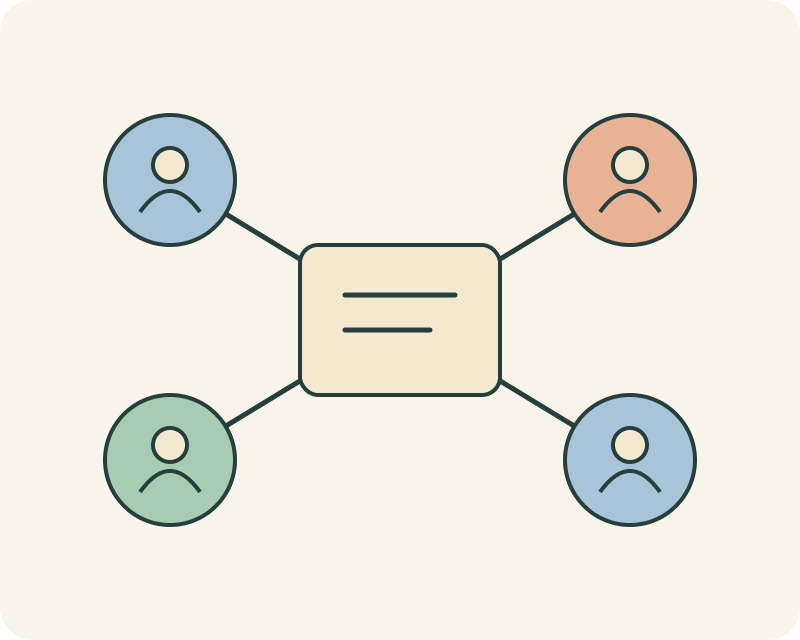
Pregunta qué función cumple cada participante en esta compra. Confirma el proceso con tu contacto y registra los roles pendientes sin inventar una jerarquía.
Delimita la compra que estás conversando
Define la decisión concreta: adquirir un servicio de catálogo digital, por ejemplo, para una distribuidora ficticia. El mapa corresponde a esa compra y a ese momento. No es una evaluación permanente de las personas ni un organigrama que puedas deducir solo de sus cargos.
La guía de OpenStax describe seis funciones posibles: iniciar la necesidad, influir en criterios, filtrar información o acceso, gestionar la compra, decidir y usar la solución. Una persona puede desempeñar varias funciones y una compra puede no involucrarlas todas. Utilizamos esa distinción conceptual para el ejercicio siguiente.
Un ejemplo con funciones que se combinan
En la distribuidora imaginaria, Laura detecta errores al enviar fichas y utilizaría el nuevo catálogo. Mateo revisa si los campos requeridos están disponibles. Inés coordina las ofertas y las condiciones. Todavía nadie ha confirmado quién puede aprobar el gasto. Esa última función queda pendiente, aunque Laura haya solicitado una demostración.
| Persona o función | Lo que sabemos | Qué falta confirmar |
|---|---|---|
| Laura | Detecta la necesidad y usaría el catálogo | Qué tarea necesita resolver |
| Mateo | Revisa campos y requisitos | Cómo comunica su evaluación |
| Inés | Coordina ofertas y condiciones | Qué documentos requiere |
| Aprobación | Sin confirmar | Quién decide y con qué proceso |
Los nombres y la empresa son ficticios. El mapa muestra preguntas por resolver, sin afirmar que exista una oportunidad comercial real.
Pregunta por el proceso con tu contacto
Puedes preguntar: “¿Quién utilizaría el catálogo?”, “¿Quién revisa los requisitos?” y “¿Cómo se toma la decisión de contratar?”. Añade: “¿Cuál sería la forma adecuada de compartir esta información con esas personas?”. La invitación de tu contacto no equivale automáticamente a permiso para contactar a toda la organización.
Si alguien coordina el acceso o la agenda, pide el formato y el canal que necesita. Evita tratar esa función como un obstáculo que hay que saltarse. Si el proceso aún no está definido, registra esa incertidumbre y acuerda qué aclaración sería útil.
Prepara información según la tarea
Laura podría necesitar ver cómo corrige una ficha; Mateo, la lista de campos y sus límites; Inés, alcance y condiciones para comparar ofertas. Estos son ejemplos de material posible, que debes confirmar antes de prepararlo. Tener funciones distintas no exige enviar versiones contradictorias de la misma propuesta.
Mantén un documento común y referencias a los apartados pertinentes. Si dos participantes piden cosas incompatibles, devuelve la pregunta al proceso de decisión del cliente. No prometas por separado dos alcances que tu equipo no puede entregar juntos.
Registra lo confirmado y lo supuesto
En cada función, anota cómo se confirmó y cuándo conviene revisarla. “Inés nos dijo que coordina ofertas” es diferente de “Inés parece tener presupuesto”. Conserva solo la información necesaria para coordinar esta compra y evita observaciones personales ajenas a la tarea.
Si cambia la persona de contacto, confirma la continuidad del proceso antes de reenviar documentos. Un correo recibido o una reunión celebrada no demuestran que la aprobación final se haya producido.
Acuerda una siguiente aclaración pequeña
Al cerrar, resume las funciones conocidas y una pregunta abierta: por ejemplo, confirmar con Inés qué paso autoriza la contratación. Asigna esa aclaración a una persona y un momento acordado; no la conviertas en una obligación inventada para el cliente.
La guía relacionada de descubrimiento ayuda a entender el problema. Este mapa añade quién participa y qué necesita para desempeñar su función; las condiciones y la decisión final deben seguir confirmándose en el proceso real.
Who uses, buys and approves? Clarify roles in a B2B purchase
The person testing a solution may need someone else’s approval to buy it. Clarifying each person’s participation helps prepare conversations and respect the process the customer actually follows.
Ask what function each participant performs in this purchase. Confirm the process with your contact and record unknown roles without inventing a hierarchy.
Define the purchase under discussion
Specify the decision: buying a digital catalog service for a fictional distributor, for example. The map concerns that purchase at that moment. It is not a permanent assessment of people or an organizational chart you can infer from job titles alone.
OpenStax describes six possible functions: initiating a need, influencing criteria, filtering information or access, managing the purchase, deciding and using the solution. One person can perform several functions, and a purchase may not involve them all. We use this conceptual distinction for the exercise below.
An example with overlapping functions
At the imaginary distributor, Laura notices errors when sending product sheets and would use the new catalog. Mateo checks whether required fields are available. Inés coordinates offers and terms. Nobody has yet confirmed who can approve the expense. That function remains pending even though Laura requested a demonstration.
| Person or function | What we know | What needs confirmation |
|---|---|---|
| Laura | Identifies the need and would use the catalog | Which task she needs to complete |
| Mateo | Reviews fields and requirements | How he communicates his assessment |
| Inés | Coordinates offers and terms | Which documents she needs |
| Approval | Unconfirmed | Who decides and through which process |
The people and company are fictional. The map shows questions to resolve without claiming that a real sales opportunity exists.
Ask your contact about the process
You might ask: “Who would use the catalog?”, “Who reviews requirements?” and “How is the buying decision made?”. Add: “What would be the appropriate way to share this information with those people?”. Your contact’s invitation does not automatically authorize contacting the entire organization.
If someone coordinates access or scheduling, ask which format and channel they need. Avoid treating that function as an obstacle to bypass. If the process has not been defined, record the uncertainty and agree which clarification would help.
Prepare information for the task
Laura might need to see how to correct a product sheet; Mateo, a list of fields and limitations; Inés, scope and terms for comparing offers. These are possible materials to confirm before preparing them. Different functions do not require contradictory versions of the same proposal.
Keep a common document with references to relevant sections. If two participants request incompatible things, return the question to the customer’s decision process. Do not separately promise two scopes your team cannot deliver together.
Record confirmation and assumptions separately
For each function, note how it was confirmed and when to review it. “Inés said she coordinates offers” differs from “Inés seems to control the budget”. Keep only the information needed to coordinate this purchase, avoiding personal observations unrelated to the task.
If your contact changes, confirm continuity of the process before forwarding documents. Receiving an email or attending a meeting does not demonstrate final approval.
Agree one small next clarification
Close by summarizing the known functions and one open question, such as asking Inés which step authorizes the purchase. Assign that clarification to a person and an agreed time; do not turn it into an invented customer obligation.
The related discovery guide helps understand the problem. This map adds who participates and what they need for their function; terms and the final decision still need confirmation in the real process.
谁使用、谁采购、谁批准?厘清 B2B 采购中的角色
试用解决方案的人,可能需要他人批准才能采购。明确每个人如何参与,有助于准备沟通,并尊重客户实际采用的流程。
询问每位参与者在这次采购中承担什么职能,与联系人确认流程,记录未知角色,不虚构层级。
明确正在讨论的采购
先界定具体决定,例如一家虚构分销商购买数字目录服务。地图对应的是此时的这次采购,并非对人的长期评价,也不是仅凭职位就能推断的组织结构图。
OpenStax 描述六种可能职能:提出需求、影响标准、筛选信息或接触、办理采购、决策,以及使用方案。一人可以兼任多项职能,一次采购也未必涉及全部角色。下文采用这一概念区分开展练习。
一个职能重叠的例子
在虚构分销商中,Laura 发现发送产品资料时有错误,也会使用新目录。Mateo 检查所需字段是否齐备。Inés 协调报价和条件。目前尚未确认谁能批准支出。即使 Laura 请求了演示,批准职能仍应标为待确认。
| 人员或职能 | 已知内容 | 待确认内容 |
|---|---|---|
| Laura | 发现需求并会使用目录 | 需要完成哪项任务 |
| Mateo | 复查字段和要求 | 如何提交评估 |
| Inés | 协调报价与条件 | 需要哪些文件 |
| 批准 | 尚未确认 | 谁决定、采用何种流程 |
人物与企业均为虚构。地图展示待解决的问题,没有声称存在真实销售机会。
通过联系人询问流程
可以问:“谁会使用目录?”“谁复查要求?”“采购决定如何作出?”再补充:“以什么方式向这些人提供信息最合适?”联系人的邀请,不等于自动允许联系整个组织。
若有人协调接触或日程,询问其所需格式和渠道,避免把这项职能当成需要绕过的障碍。流程尚未确定时,记录不确定性,并约定哪项澄清有帮助。
按任务准备信息
Laura 可能需要看如何纠正一份产品资料;Mateo 需要字段清单及限制;Inés 需要用于比较报价的范围与条件。这些只是可能材料,准备前应先确认。职能不同不意味着需要互相矛盾的提案版本。
保留共同文件,并指向相关章节。两位参与者提出不兼容要求时,应交回客户的决策流程讨论。不要分别承诺团队无法同时交付的两种范围。
区分已确认内容与假设
记录每项职能如何确认、何时复查。“Inés 说她协调报价”不同于“Inés 看起来掌握预算”。只保留协调这次采购所需的信息,避免与任务无关的个人评价。
联系人改变后,先确认流程是否延续,再转发文件。收到邮件或开过会议,都不能证明已获最终批准。
约定一项小范围澄清
结束时概括已知职能和一个开放问题,例如向 Inés 确认哪个步骤授权采购。约定由谁在何时澄清,不要把它变成强加给客户的义务。
相关需求发现指南帮助理解问题;此地图补充谁参与、履行职能需要什么。条件与最终决定仍须在真实流程中确认。
Fuentes y método
Fuentes consultadas el 31 de octubre de 2026. Los casos, personas, códigos y cifras ilustrativos son ficticios. Son propuestas y ejercicios editoriales originales, sin atribuir registros de servidor, pruebas de tiendas, siembras ni resultados de clientes realizados. Editorial standards · Disclosures.