Present the game’s map and rehearse a turn without scoring. Then let each person decide, with the correct edition’s rules nearby.
Agree what kind of session the group wants
Before laying out components, ask how much time is available, who knows the game and whether people prefer a practice round. Explain whether play is competitive or cooperative and what reading, space or handling it requires. Check concrete needs without assuming them from someone’s experience.
Prepare a table where components are reachable and references readable. Our creative spaces guide helps consider functions before furniture; here the task is sharing an activity, rather than designing a game room.
Explain the map before the exceptions
- What each person or the group is trying to achieve.
- What the components needed at the start represent.
- Which actions make up a normal turn and which decision is chosen.
- What ends the game and how the result is determined.
- Which special rule could affect the first decision.
Show pieces as you name them. If an exception changes the cost or legality of an initial action, explain it before someone chooses. Other rules can be located in the reference as they arise, without withholding information someone needed for a decision.
Rehearse a decision with visible pieces
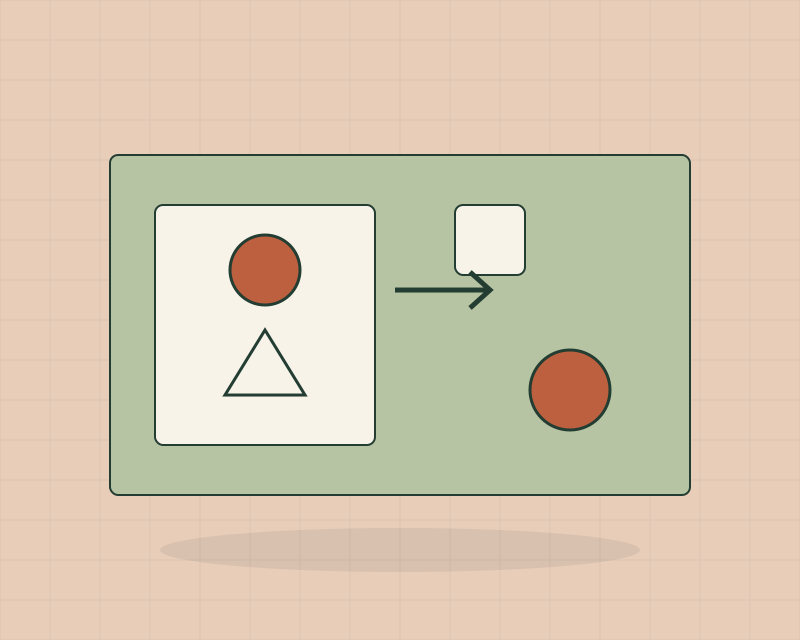
This fictional fragment, “Three Signals,” only demonstrates an explanation: it is neither a complete game nor an adaptation of a published one. The shared area contains circle, triangle and square tokens. The exercise’s objective is to collect all three different shapes; the practice turn consists of choosing a visible token and moving it to your area.
The teacher points out the options and takes a circle as a demonstration. Another person then chooses a shape and describes what they did. Shapes distinguish tokens without relying only on color. At the end, everything returns to its initial position; practice does not score.
For a real game, demonstrate its complete turn under its own rules, including replenishment or effects where applicable. Do not add this exercise’s rules to a published game. Ask “What options do you have now?” to check the explanation without making it a test.
Help without playing someone else’s turn
Offer to clarify known consequences before recommending a move. “You can choose among these actions” preserves more autonomy than moving someone’s pieces for them. If they request a suggestion, explain the reasoning and let them confirm the choice.
An experienced player can help look up a rule without correcting every decision as though there were only one way to enjoy play. Agreeing on a learning game does not remove its rules: it makes handling late-discovered mistakes explicit.
Look up a question in the correct edition
Keep the relevant rulebook nearby and check for official clarifications. As an example of organized lookup, the official Vantage reference includes rules, frequently asked questions and errata. Its existence does not make those rules applicable to other games or mean that this publication tested that product.
For a question, identify the action and exact moment, locate the passage and read it to the group. Distinguish a found rule from a provisional table agreement. If using a house variant, identify it as such and apply the same agreement to everyone.
Keep one improvement for the next explanation
Afterward, ask what was difficult to understand and which reference helped. Keep a short note for the next gathering: perhaps the ending needed explaining earlier or a piece needed an example. Our reading notebook offers another way to record learning without copying all the material.
As with our layered listening exercise, a second pass can reveal something the first did not. Teaching aims to let the group participate and decide; it does not require reciting the entire rulebook or attributing unobserved benefits to a game.
Follow the evidence.
Sources checked October 21, 2026. Illustrative scenarios and numbers are fictional. The records and exercises are original editorial proposals, without attributed customer results or provider tests. Our editorial standards.