Change only the joining twist and observe two different paths: one along the surface’s center and another beside its boundary.
Prepare identical strips
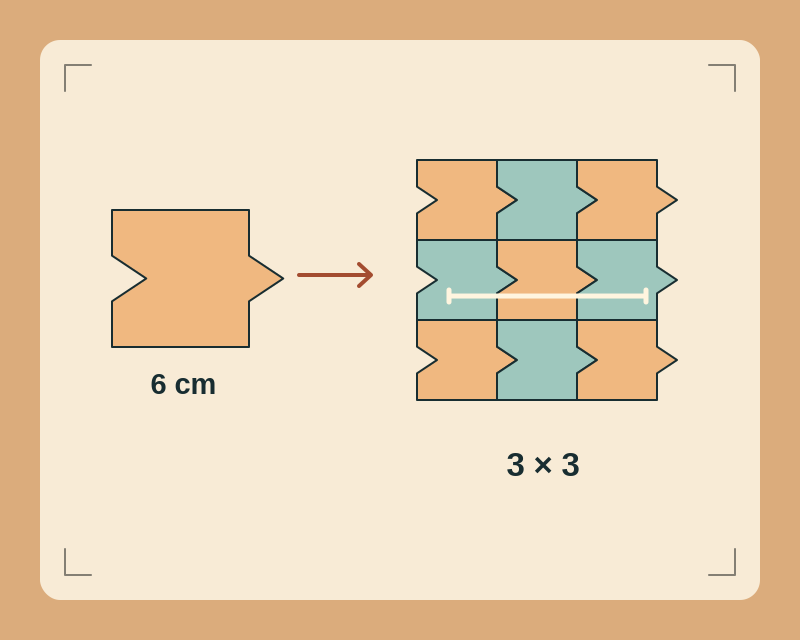
Cut two strips measuring 28 by 3 centimeters and gather tape, a pencil and two colors. These dimensions are a practice choice, not a special mathematical requirement. Mark each strip A or B near one end.
The activity studies a surface model, ignoring paper thickness and joining tape. By boundary, we mean the strip’s long edges remaining free after the short ends are joined, rather than the material’s microscopic thickness.
Change just one join
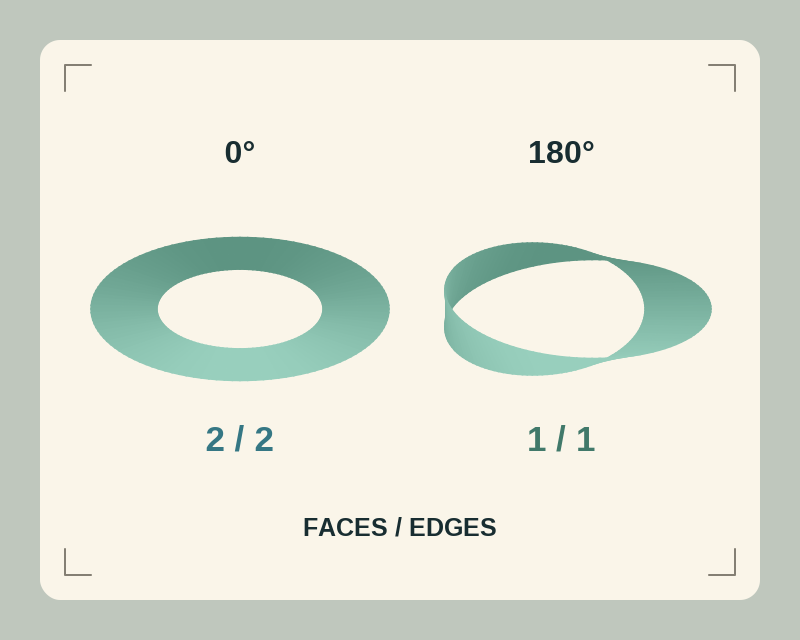
Bring A’s short ends together and tape them without twisting, producing an ordinary loop. For B, rotate one end by a half-turn, 180 degrees, and join it to the other. Align the ends without leaving a loose section or flattening the entire band.
The second join creates a Möbius strip. The University of Wisconsin–Madison museum describes building both forms and following their surfaces. The Royal Institution describes the Möbius band as a surface with one face and one boundary.
Draw a center path
On A, mark a point approximately halfway across the width and draw along the center until returning exactly to it, without crossing a boundary. The line stays on one of the loop’s two faces; the other retains an unmarked center.
Repeat on B. Continue through the taped join, stopping only when the path reaches its starting point rather than merely seeing the tape again. Move the band as needed to follow the line. The path reaches both regions that seemed to be front and back before joining.
Then trace the boundary
Use another color to follow a line close to one free boundary of A. After completing that path, another independent boundary remains. On B, follow one boundary back to the start: that same path includes what were both long edges of the open strip.
You do not need to cut the loops for this comparison. Keep center-path and boundary results separate. Having one face and one boundary are distinct properties observed through two tests, even though they occur together in B.
Keep predictions and observations
Before drawing, write how many paths you expect in each band. Then record twist, center result, boundary result and any difficulty at the join. If a shape behaves unexpectedly, check how many half-turns you gave it.
The paper sample explores continuity without formally proving every topological property. Keep both models and explain to someone else how to follow each path: the route says more than calling the shape “strange.”
Follow the evidence.
Sources checked November 24, 2026. The exercise scenarios and figures are fictional. Our editorial standards.