Keep valid answers from 0 to 10, classify them using NPS boundaries and use that common total for both shares.
Keep the question and scale
Bain's method asks how likely someone is to recommend the company to a friend or colleague, on a zero-to-ten scale. Record wording, timing and who was invited. A question about satisfaction with a closed case measures something different; do not automatically turn those answers into NPS.
Classify without moving boundaries
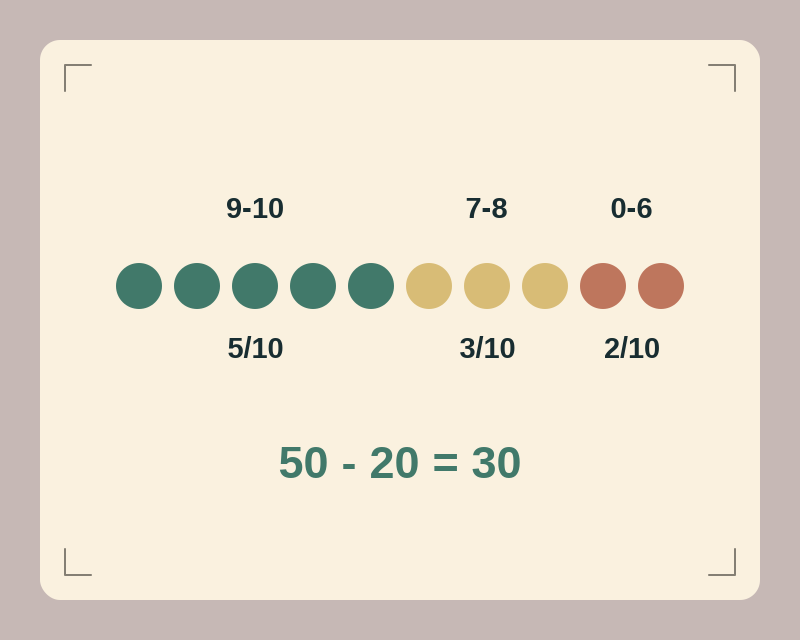
In NPS, ratings 9 and 10 are promoters; 7 and 8 are passives; and 0 through 6 are detractors. Our fictional set contains five promoters, three passives and two detractors. An 8 does not become a promoter because it seems high on another scale.
Reconstruct the result
Promoters: 5 / 10 = 50%. Detractors: 2 / 10 = 20%. NPS is 50 − 20 = 30, expressed as a score. The three passives remain part of the ten valid responses. Using only the seven responses at the extremes would yield about 42.9 and change the method.
Separate nonresponse from a passive rating
A 7 or 8 supplies a rating and receives a classification. An unanswered invitation or an out-of-scale value needs a different record. Keep invitation counts, valid responses and exclusions with reasons. Ten answers do not automatically reveal what the whole customer base thinks.
Read comments before deciding
Keep each group's count alongside NPS and review comments in context. With ten responses, one person moving from passive to promoter changes the result by ten points, all else unchanged. The classification summarizes ratings; it does not establish that someone has already referred the company or will buy again.
Follow the evidence.
Sources checked November 21, 2026. The exercise scenarios and figures are fictional. Our editorial standards.