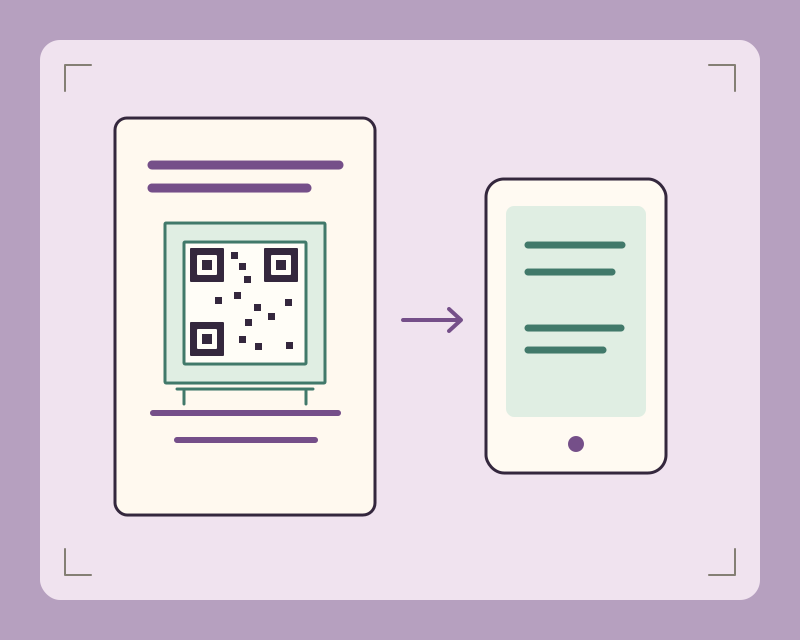
Describe the destination in words beside the code. Keep a readable address and test both routes on a printed copy.
Say what will open
Use wording such as “Check opening hours and directions.” Name the task someone can complete on the page. If you change the destination to a reservation, review the invitation too. In the example, the first page content answers questions about hours and access.
Put a short address near the symbol. A mock-up can use museo.example/visita. On a real poster, check that the printed address opens the intended destination and can be typed from what the reader sees.
Leave room for the margin
DENSO WAVE explains that a standard QR Code needs a clear margin of four modules on each side. A module is one cell in the pattern. If the example symbol is 29 modules across and each module is 0.5 mm, reserve a square of 37 modules including the margin, or 18.5 mm across.
This calculation explains the space in the mock-up. A working poster size depends on reading distance, printing and placement. Keep photos, borders and text out of the margin.
Test the print where it will be used
Print a copy at final size. Try it with two phones from a position that makes sense for a passerby, under the available light. If the poster will have a glossy cover, test with the cover in place too. Record where scanning stopped working and what you changed before printing again.
Check the destination after opening it
Read the screen from the start. Check the final address, the first visible information and whether an unexpected sign-in is required. Ask someone else to type the short address. Record separately what scanning opened and what the address opened.
Keep a record for the next print run
Save the poster version, test date, code file, printed address and final destination. If the page moves, check both routes before replacing the poster. Keep a proof copy to check readability at actual size.
Follow the evidence.
- DENSO WAVE · Point for determining the code area ↗
- GS1 · 2D Barcodes at Retail Point-of-Sale Implementation Guideline ↗
Sources checked November 11, 2026. The exercise scenarios and figures are fictional. Our editorial standards.