Freeze an original version and review terms, facts and exceptions separately. Approve the published layout too, and record who resolved open questions.
Provide a reviewable reference
Gather the approved original, images containing words, links and target audience. Identify its version and date. A correction during translation must reach every edition before approval.
The European Commission DGT distinguishes accuracy, terminology, style and design errors. We use those questions for a fictional commercial page without reproducing its scoring system.
Separate what the page must preserve
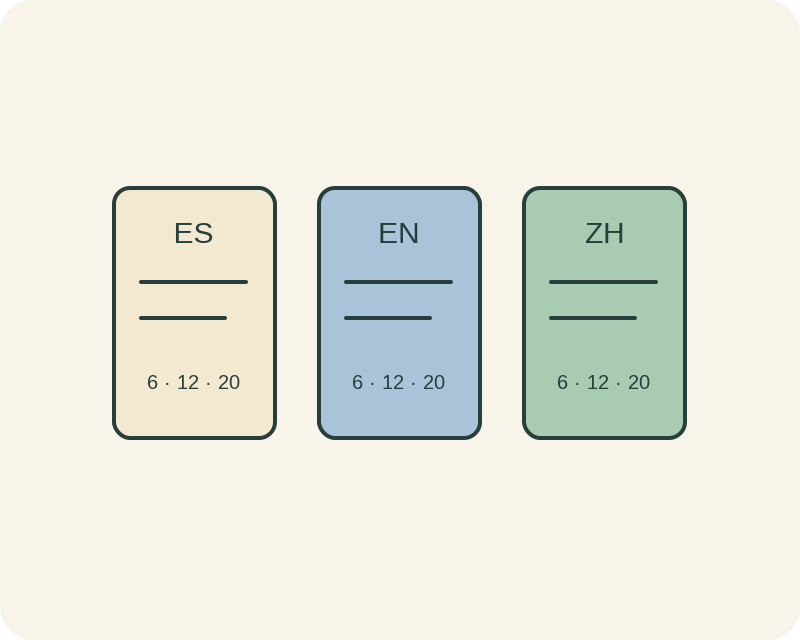
The imaginary Luma product has this Spanish source: “Caja de 6 cuadernos. Reserva hasta el 12 de noviembre de 2026. Recogida a partir del 20 de noviembre de 2026. No incluye envío”. Luma stays unchanged in this exercise.
| Element | Value to preserve | Question to resolve |
|---|---|---|
| Contents | 6 notebooks per box | Box or individual item? |
| Preorder | By November 12, 2026 | Is the deadline preserved? |
| Pickup | From November 20, 2026 | Is delivery being promised? |
| Exception | Shipping excluded | Does omission change the offer? |
A real sales deadline may also need a time and zone. If the source does not define them, request clarification before adding them to a translation.
Build a small glossary with context
For this page, reserva becomes preorder in English and 预订 in Simplified Chinese. Recogida becomes pickup and 自取. Context distinguishes reserving goods from booking an appointment.
Record the source term, proposal, example sentence and decision owner. Three terms that resolve an ambiguity help this review more than a long list without context.
Read the complete offer in each language
English proposal: “Box of 6 notebooks. Preorder by November 12, 2026. Pickup from November 20, 2026. Shipping is not included.” Chinese proposal: “每盒 6 本笔记本。预订截至 2026 年 11 月 12 日。2026 年 11 月 20 日起可自取。不含配送。”
Compare quantities, timing and the exception against the original. Then request a natural reading from someone competent in the target language, with questions visible.
Review the actual layout
Open the composed version, including images, buttons, links and error messages. W3C recommends considering translation of images and examples, local formats and navigation between languages. Check that shortening a button or cropping an image has not removed a condition.
Brand voice guides tone. This review also asks whether the reader receives the same complete offer.
Approve a version with questions resolved
Keep the original, translation, agreed terms, corrections and layout proof. Classify questions by how they affect a customer decision. Resolve quantities, dates and exclusions first, then record linguistic and editorial approval.
Follow the evidence.
- European Commission DGT · Translation quality evaluation, 2024 ↗
- W3C · Internationalization Quick Tips for the Web ↗
Sources checked November 5, 2026. Illustrative scenarios and numbers are fictional. Original exercises and records, without attributed customer results or field observations. Our editorial standards.